With the return of mild temperatures, April marks the true beginning of the caterpillar season in France. In gardens, hedges, pathways, or simply on house walls, several species suddenly become very visible. Some are tiny, others are already well-developed, but they all have one thing in common: they are the ones you are most likely to encounter in the spring, without needing to be an expert naturalist. Here are the caterpillars you are most likely to come across in April, and how to easily recognize them.
The Angle Shades (Phlogophora meticulosa)
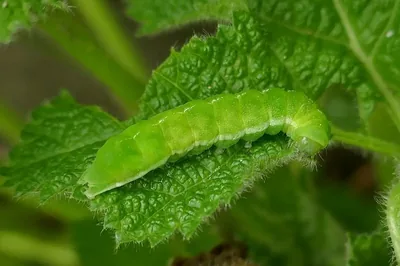 This is the typical “garden caterpillar” that everyone sees without knowing its name. It can be found absolutely everywhere: in vegetable gardens, on terraces, walls, lawns, or even at the bottom of flower pots. Although it feeds mainly at night, it is very often caught in broad daylight, motionless, during a session of gardening or weeding. Its color varies from soft green to brown-ochre. → Discover the complete file for the Angle Shades
 The Lesser Yellow Underwing (Noctua comes)
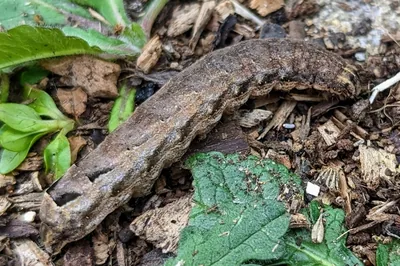 After spending the winter well sheltered, it emerges from hibernation and becomes active with the first warm days of April. At this time, they are literally everywhere: on hedges, young spring leaves, shrubs, and low-growing plants. With a rather discreet color, varying from brown to grayish-brown, it often goes unnoticed unless you are actively looking for it. → Discover the complete file for the Lesser Yellow Underwing
 The Large Yellow Underwing (Noctua pronuba)
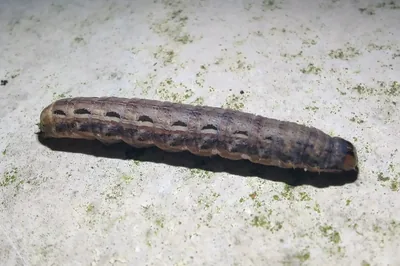 Very close to the Lesser Yellow Underwing, this caterpillar is just as common in our green spaces. It is a true all-rounder that can be observed on a wide variety of low-growing plants such as plantain, dandelion, lettuce, or strawberry plants. It is naturally very calm, and its coat can take on several very different shades from one individual to another: from green to brown, including ochre. → Discover the complete file for the Large Yellow Underwing
 The Pine Processionary (Thaumetopoea pityocampa)
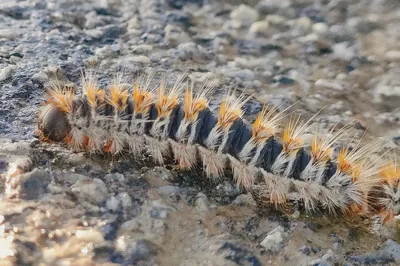 Depending on the region, April corresponds to the time when they descend from their trees in long single-file lines to go bury themselves in the ground. This is the most dreaded species of spring due to its urticating hairs which can cause skin reactions in humans and animals. Their presence is easily spotted thanks to the large white silk nests woven in the branches of pine trees. → Discover the complete file for the Pine Processionary
 The Garden Tiger (Arctia caja)
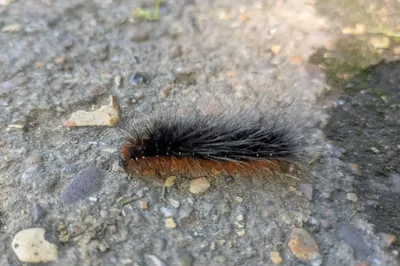 This is the ultimate "hedgehog caterpillar". After spending the winter hidden, it resumes a frantic activity in April to complete its growth. It is often seen crossing pathways or roads at full speed. It is spectacular with its very dense bicolored fur: black on top and bright reddish-orange on the sides. No need to worry, its long hairs are not urticating! → Discover the complete file for the Garden Tiger
 The Fox Moth (Macrothylacia rubi)
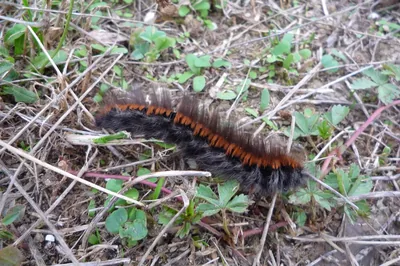 This is one of the largest hairy caterpillars visible in spring. After spending the whole winter asleep as a caterpillar, it comes out on the first beautiful days of April to "sunbathe" on the pathways before turning into a chrysalis. At this stage, it no longer feeds. When it feels threatened, it has the typical reflex of rolling up on itself to form a perfect disc. Its hairs are not urticating either. → Discover the complete file for the Fox Moth
 If you found a caterpillar and do not recognize it, you can use the site's identification tool to get a quick and reliable answer.